
Water Conservation
DRINKING WATER IS A PRECIOUS NATURAL RESOURCE
Hooksett Village Water Precinct is committed to reducing water losses, water waste and water use in accordance with our State-approved Water Conservation Plan. For example, to reduce water losses we implement a vigilant leak detection survey and repair program. Additionally, we reduce water use by minimizing tank overflows, optimizing equipment operations and employing a tiered water conservation-based rate structure. To reduce water waste, we encourage the use of new water efficient fixtures, educate customers about water conservation and have completed a water meter modernization program. Through the implementation of these approaches, our system and our customers not only achieve water efficiency, but also energy efficiency through reducing energy usage associated with pumping, treating, distributing and using water.
We have been honored for our efficiency initiatives by the New Hampshire Department of Environmental Services based, in part, on our "outstanding efforts to maintain the sustainability of the Precinct’s groundwater sources through asset modernization, strategic planning, and water efficiency outreach, as well as a commitment to proactive water loss control." The Precinct was also invited to co-present well-attended seminars on extreme weather preparation at the 2021 NH Drinking Water Exposition (with NHDES and Plymouth Village Water & Sewer District) and at the 2023 Climate Change Workshop sponsored by Granite State Rural Water Association. Our portion of the seminars focused on lessons learned in Hooksett during the droughts of 2016 and 2020, and the application of source, asset and financial management tools to reduce drought impacts in public water supply settings. A copy of our 2023 presentation is provided below.
"Water efficiency is a crucial component to ensuring enough clean water for today and for the future.
Water is a finite resource, meaning we cannot make more water to meet the increased competing demands of a growing population and economy. We also do not have full control over water quality or quantity due to the geologic makeup of our state, climate change, lingering pollution issues left by past generations, and new emerging contaminants of concern. So how do we adapt to the upsurge of competing water demands knowing that there are limitations to the quality and the availability of water supplies?
We use only what we need."
Brickyard Brook Diversion
Historically, HVWP pumped and disinfected water from Pinnacle Pond to serve the Precinct. This spring-fed water body had served as the Village's public water supply since the late 1800s in some fashion or another, but it became clear that it would not be enough forever. In 1958, the Precinct sought a creative solution to supplement this source in preparation for projected demand associated with planned developments in the Village. After two years of logistical planning and approvals, roughly a mile of 16" pipe was installed to bring water from a small dam on Brickyard Brook to the southern end of Pinnacle Pond. When there was enough water in the brook, a gate valve near the end of Vista Drive could be opened to divert a portion of the brook's flow to artificially fill Pinnacle Pond. The diversion was first used in 1961, adding 17 million gallons to the pond and raising it 28 inches in about a week during the spring. This ingenuity helped pave the way for expansion throughout the next two decades. Though the Precinct eventually switched to groundwater sources (wells) to comply with Federal regulations in the late 1980s, the diversion still indirectly benefits the water supply by recharging the aquifer below Pinnacle Pond, which the wells tap into.
Little documentation exists for diversions prior to the mid-2000s, but when the Precinct installed what is now referred to as the East Well in 2004, a Large Groundwater Withdrawal Permit (LGWP) was needed. Applicable to wells drawing over 40 gallons per minute installed after August 1998, LGWPs allow the NH Department of Environmental Services to place monitoring requirements on the permit holder. In our case, one such stipulation relates to use of the diversion while maintaining sufficient flow in Brickyard Brook and recording the volume diverted to Pinnacle Pond. HVWP is diligent about monitoring pond and brook levels to keep the pond topped off whenever possible, while ensuring that diversions occur only when the minimum streamflow is maintained in order to protect aquatic life. This involves dataloggers, transducers, pond gauges, and frequent stops by the weir beneath RT3A where the brook meets the Merrimack River and streamflow is measured.
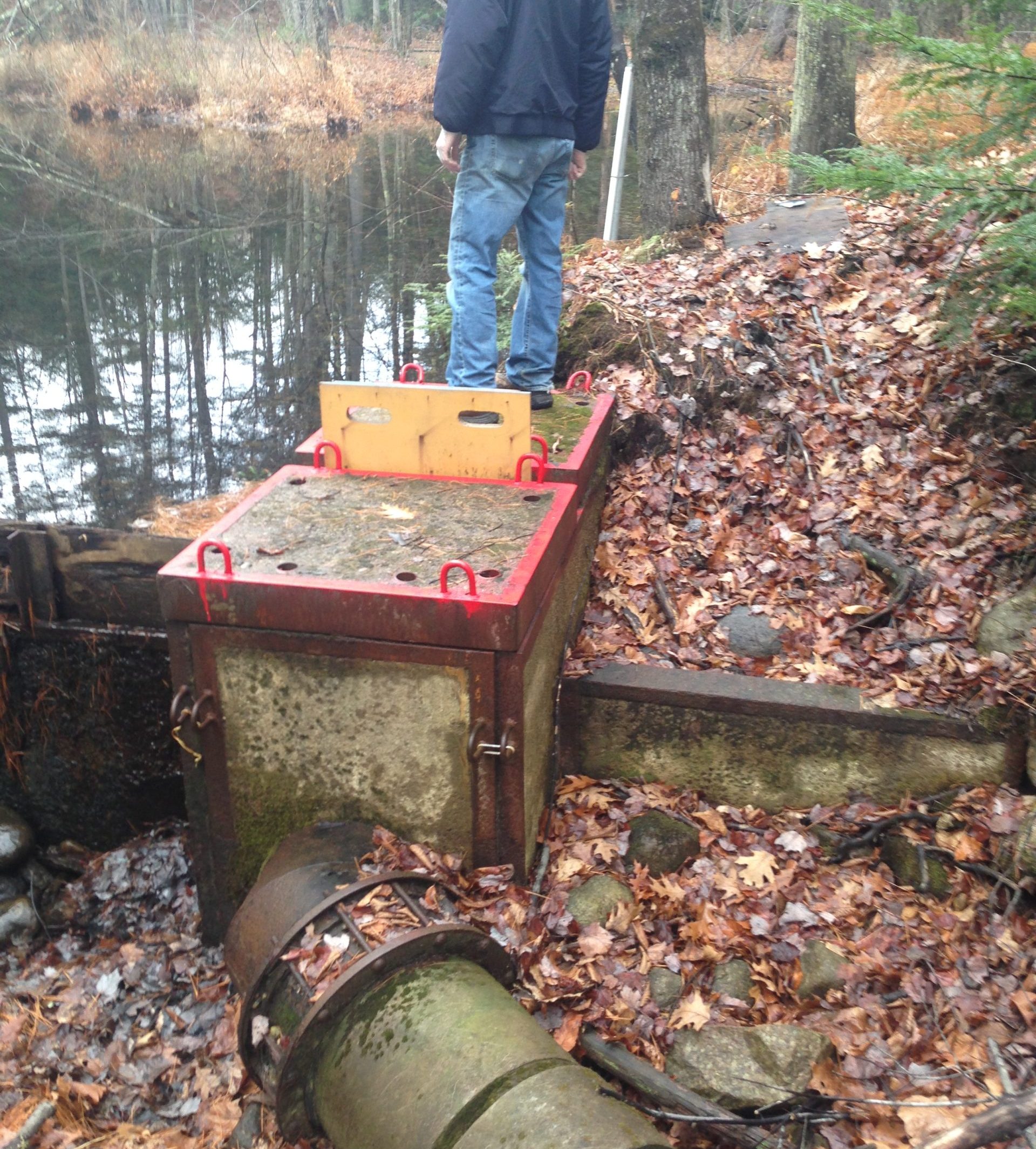
The dam on Brickyard Brook with the board in the diversion box to prevent flow into the 16" asbestos cement (AC) pipe.
In August 2025, HVWP made improvements to the dam on the west side of I93 to better control when flow enters the diversion pipe. Historically, when conditions for diverting into Pinnacle Pond were not favorable, HVWP would route the water back into Brickyard Brook at the gate valve, but this practice was discontinued in 2011 to better ensure flow throughout the streambed. A board was placed to block the intake to prevent flow and then raised or removed for diversions, but it was never quite watertight, causing a potential for issues in the summer when precise flow control was not possible and in the winter when water would pool in the diversion pipe and freeze due to low flows and temperatures. With the installation of a knife gate valve in 2025, this mechanism has been improved.
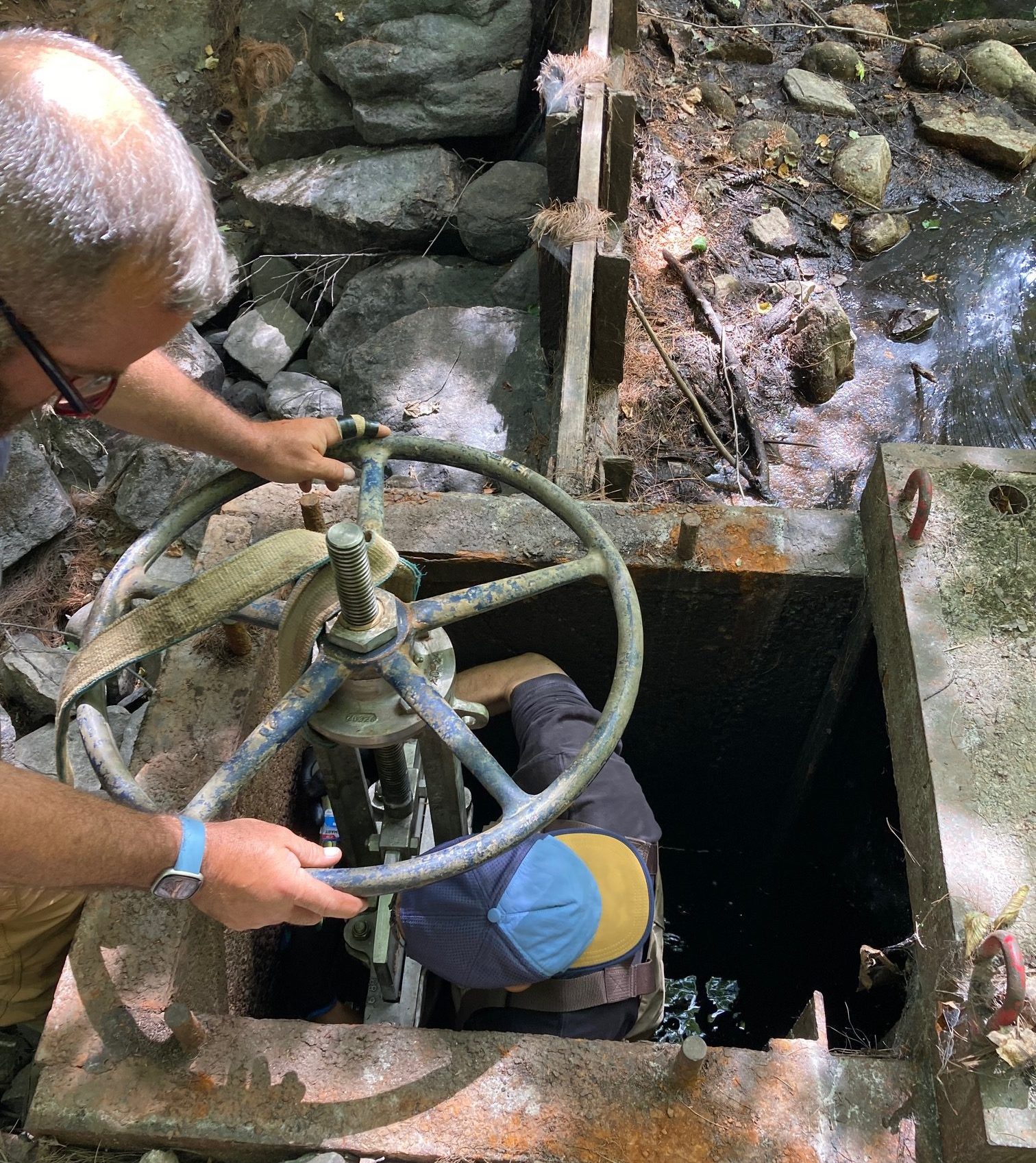
Operators Dennis Bell (left) and Jeff Wright (right) installing the knife gate valve in the diversion box in August 2025 to improve flow control.
HELPFUL LINKS:
STATISTICS & DATA
USGS New England Water Use Data
AWWA Residential Water Use Statistics
NH DES Water Efficiency Fact Sheets
GENERAL CONSERVATION
CA Degrees - Ultimate Guide to [Home] Water Conservation
The Hooksett Way of Life (tips for the home and yard, adapted from Save Our Water)
FEMA Water Conservation Tips
Technical Reference Manual for Water Efficient Homes - Indoors/Outdoors
MWRA Water Efficiency At Home
WaterSense - Efficient Appliances, Landscaping & Building
OTA Industrial Water Conservation Techniques
IRRIGATION
UNH Water Conservation Fundamentals in Gardening & Landscaping
MWRA Garden & Landscaping Tips
Questions to Ask Your Landscaping Contractor
Simple Landscape Irrigation System Maintenance Checklist
NH Landscape Contractors Trained in Water Resource Protection
WaterSense - Irrigation Controllers
Save Water in the Yard This Summer
DROUGHT
How Do I Keep My Lawn Alive In A Drought?
When In Drought - Home Water Conservation Tips
NH DES Drought Information Page
HVWP's 2023 PWS Drought Preparedness Presentation
HVWP's 2023 PWS Drought Preparedness Presentation (Video)
STORMWATER
NH Homeowner's Guide to Stormwater Management (DIY solutions)
Low Impact Development & Stormwater Management - NH DES fact sheet
Soak Up The Rain NH (rain gardens & barrels)
Managing Rainwater at Home - April 2023 NH DES presentation
Hooksett Garden Club